iCHARM, a powerful new platform designed to make NOAA’s vast weather and climate datasets more accessible to students, educators, researchers, and the public, was unveiled at the 12th Biennial NOAA Educational Partnership Program (EPP) Education and Science Forum, held July 20–23 at the City University of New York (CUNY).
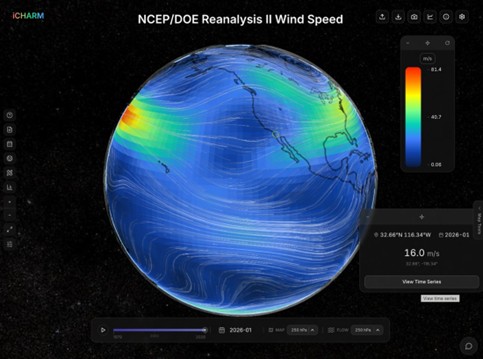
Developed under the leadership of NOAA Center for Earth System Sciences and Remote Sensing Technologies (CESSRST) EPP Fellow Jonathan Siegel at San Diego State University (SDSU), the Cyber Hub for Analytics, Research and Monitoring (iCHARM) (URL: https://icharm.app) provides users with an intuitive, web-based platform for visualizing, analyzing, and exploring large environmental datasets—without requiring programming experience.
The project was completed under the leadership and guidance of Distinguished Professors Dr. Sam Shen, CESSRST II partner lead at San Diego State University (SDSU), and Dr. Mitch Goldberg, CESSRST II lead at the City College of New York (CUNY, CCNY).
Designed to broaden access to NOAA data, iCHARM enables users to generate interactive maps, time series, atmospheric and oceanic flow visualizations, and perform statistical analyses, including anomaly detection, seasonal analysis, regional statistics, and spectral analysis. The platform serves a wide range of users, from K–12 students and university classrooms to scientists, engineers, and decision-makers.
The software represents approximately 18 months of collaborative development by the iCHARM team. Led by Siegel, the group produced approximately 110,000 lines of code, processed thousands of datasets, and reviewed hundreds of technical documents to standardize metadata, visualization settings, units, color scales, and temporal and spatial parameters.
To make weather data more engaging and accessible, iCHARM incorporates visualization techniques inspired by modern video game technology while employing database optimization methods that allow users to rapidly access and interact with large NOAA datasets.
The iCHARM project also benefited from the grant support from and the research collaboration with scientists at NOAA’s National Centers for Environmental Information (NCEI), including Steve Ansari, Jeff Privette, Michael Brewer, Russ Vose, and Boyin Huang. Their guidance helped shape the platform’s mission to increase the use of NOAA data while supporting more resilient ecosystems, communities, and economies.
Reflecting on the project, Siegel credited the NOAA Educational Partnership Program for providing the opportunity to contribute to a tool with broad educational and scientific impact. “My EPP fellowship mentors, Sam Shen at SDSU, Mitch Goldberg at CUNY, and Steve Ansari at NOAA/NCEI, instilled in me the values of ambition, responsiveness, and reliability,” said Siegel.
The experience also prepared him for the next stage of his career, leading to his acceptance of a position with General Atomics, where he will contribute to projects of national defense importance, such as unmanned aerial vehicles (UAVs).
Through projects like iCHARM, NOAA EPP continues to foster the next generation of STEM leaders while advancing innovative tools that expand access to NOAA science and data for communities nationwide.
Demonstrating this impact, three iCHARM student researchers—Christian Byars, Caleb Thai, and Leland Cuellar—were recently awarded EPP fellowships.